
Rhiwbina Tea Gardens: A History
Nov
Nigel Lewis explores the story of Rhiwbina’s tea gardens, once a favourite stop for visitors and villagers alike
It’s often said that Rhiwbina as a village only started a little over a hundred years-or-so ago. I’m not sure about that, but you have to accept that Rhiwbina only grew from a tiny hamlet after the arrival of the railway line and the station.
It was some years after that, when the awful potholed tracks in the area began to improve, that a regular bus service started between town and the village. I’m told that the terminus was the roundabout at Deri Stores.
We have old photographs of these first buses, single-deckers with both a driver and ticket collector. I wonder what colour the liveries were? It’s impossible to tell with black-and-white photographs. The bus route soon became popular with Cardiff residents who wanted to ‘take a trip’ to the Wenallt, particularly in fine weather, at weekends, and most of all during public holidays.
It’s all very well taking a picnic with you, but lots of folk wanted a little more.
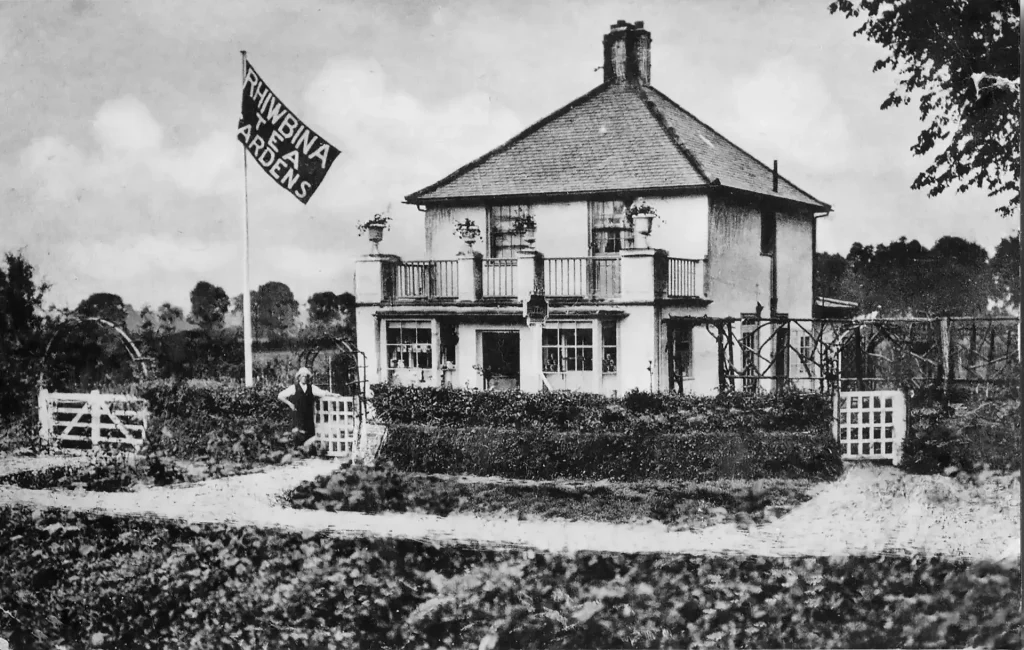
Will Smart, who’d arrived in Rhiwbina in the middle of WWI, was a wheelwright and had moved into a house with a large garden on Heol-y Deri, just down from the bus terminus.
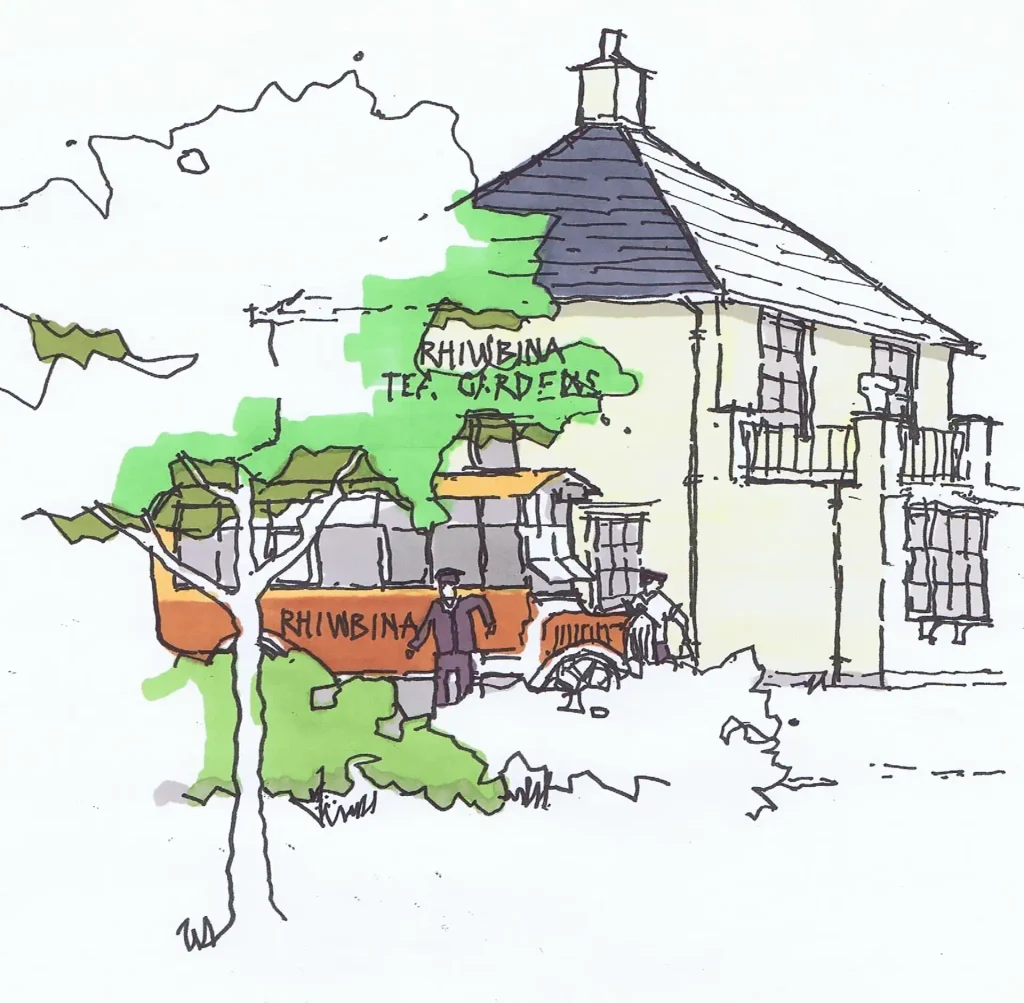
He saw the opportunity of opening a tearoom at his home to meet the needs of the visitors. He called it the Rhiwbina Tea Gardens, and it soon became a focal point for the village. The sketch showing the tearoom and an early bus is so evocative.
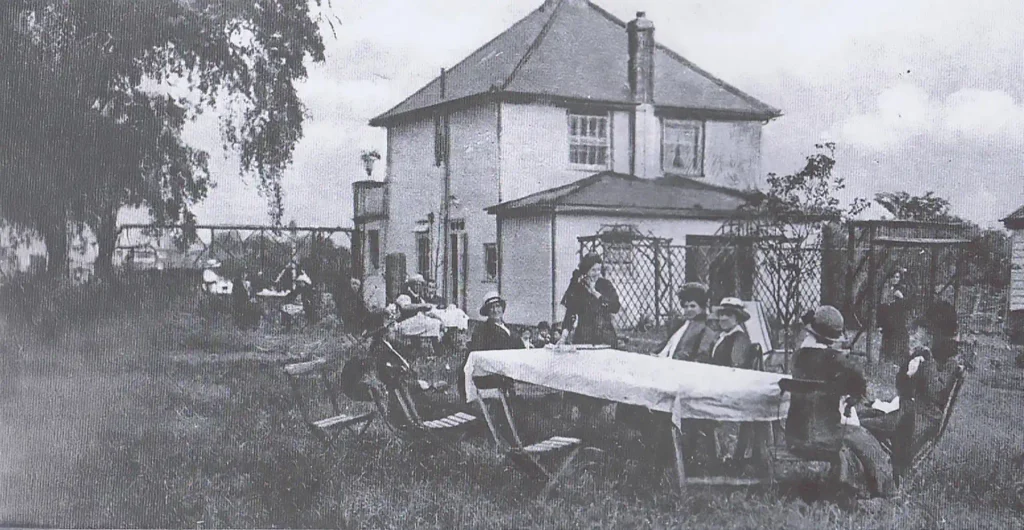
Clearly, the project was successful. Outdoor teas for visitors became an essential part of any trip, particularly for ladies in hats, as the old photograph shows! I guess that you didn’t even need to be a visitor to pop into the tearoom.
Over quite a short time, and as the business grew, the house was extended to allow folk to take tea indoors – on those rare occasions when it rained in Rhiwbina. You wouldn’t want to ruin your hat! Did Will acquire more land at the rear? Later photographs suggest that the premises had become much larger.
I’ve discovered that as the business grew, additional attractions were added: a putting green and aviaries with exotic birds. There are tales that the whole thing grew into something of a zoo, with monkeys and the like. Perhaps there are a few who still remember the stories?
All this seems to be lost now, but who were they, the ladies who served the tea, the cakes, and the cucumber sandwiches? Who were the folk who partook of the goodies, and who were the special few who looked after the putting green and the animals?
Within a few years, Will – who was obviously something of an entrepreneur – began to dabble with the maintenance of motor vehicles, which were beginning to appear. It looks like he acquired a plot of land immediately adjacent to the tea gardens and started the Rhiwbina Motor Garage.
This business really took off; I wonder for how long the tea gardens and garage continued in conjunction?
By the late 1920s, there were more places in the village offering tea to visitors, and in that time of recession, the family must have made the hard decision to wind down the tea gardens.
In the years before WW2, the garage was not only selling petrol and oil, and repairing cars, but had begun an association with Morris Motors to sell brand new cars too. Perhaps your family was one that bought a car there. Will sadly died in 1937, and the business was inherited by his son, Cliff. He was already running his own business, Brook Garage, just behind Beulah Chapel in the middle of the village; the whole thing became Cliff Smart Ltd.
By 1987, with Cliff now past retirement himself, another hard decision was made, to close the garages and to sell the tea gardens site for development. Today, there’s no sign of the tea gardens or either of the garages.
In the village, there’s Nest, a gift shop with a strange concrete forecourt. On Heol-y-Deri, there’s a development of flats and houses called Clos-y-Ardd – this translates as Garden Close. Perhaps both sites deserve plaques to remind visitors of Rhiwbina in those earlier times. Maybe a photograph or two, showing the old tea gardens or the petrol pumps, might help.
If any of this jogs a memory, why not send a note to Rhiwbina Living? I’m sure many readers would be fascinated to learn more of these iconic corners. I know I would!
Nigel Lewis is a member of AWEN@thelibrary (awen.cymru@gmail.com) and now a member of the Rhiwbina Local History Group, meeting at the Rhiwbina Hub.
